

Sit.
On silence, Pascal, the Rocky Mountains, and the fifteen pieces of music that taught me what I couldn't say in words.

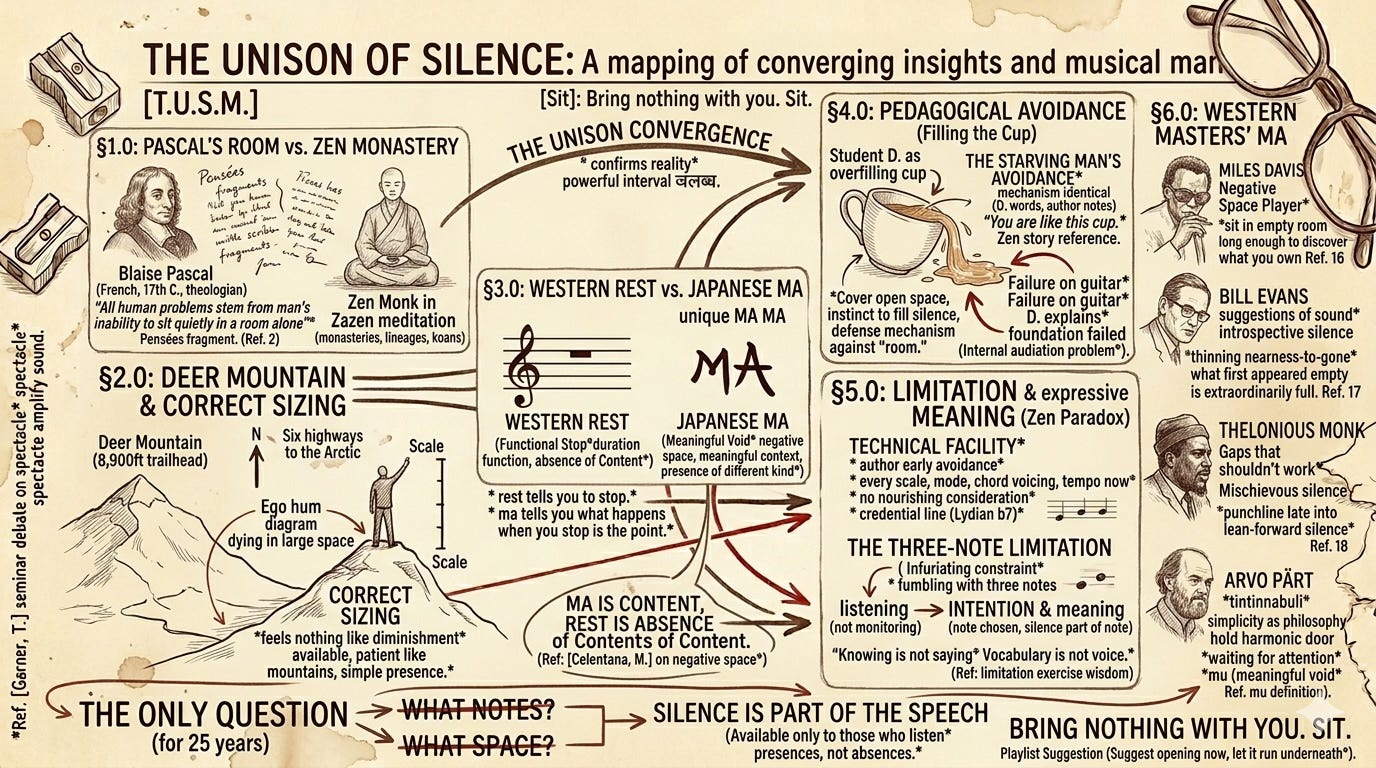
A playlist for this essay is waiting for you at the bottom of the page. I’d suggest opening it now and letting it run underneath everything that follows. If that seems like a strange instruction — reading an essay while listening to music about silence — then you’ve already encountered the essay’s first argument.¹
****
Blaise Pascal, mathematician, physicist, inventor of an early mechanical calculator, and — this being the seventeenth century, when a man could still do all of these things before lunch without anyone accusing him of showing off — committed Catholic theologian, wrote the following in his Pensées, a collection of philosophical fragments assembled after his death from the scraps of paper and bits of parchment he’d been scribbling on for years: “All of humanity’s problems stem from man’s inability to sit quietly in a room alone.”²
You have perhaps encountered this quote before, floating untethered in the ambient wisdom-fog of the internet, attributed variously to Buddha, to Lao Tzu, to “ancient Zen proverb,” to the general Eastern philosophical tradition, which is to say attributed to the vast, undifferentiated repository of foreign profundity that the Western internet tends to reach for when it wants to sound contemplative without doing any actual work. The attribution is always wrong. The quote is Pascal’s. He was French. He was Catholic. He died at thirty-nine having accomplished more than most people accomplish across three consecutive lifetimes, and in the middle of all of it he stopped, looked at the whole of human civilization, and concluded that the core problem — the root system beneath every war, every cruelty, every small and large catastrophe we have managed to visit upon ourselves and each other — was simply this: we cannot be alone, in a room, in silence, with our own thoughts.³
Which is, when you sit with it for a moment — and I am asking you, gently but with complete seriousness, to actually do that right now, to pause here, to let a beat of silence land before you continue — a devastating observation. And also a funny one. The audacity of the reductive. The whole of human suffering, Pascal says, and then names a thing so small, so available, so embarrassingly achievable that its unavailability becomes the joke. The room is right there. The chair is right there. Sit down. Stop. Be quiet.
Reader, we cannot do it.
Now: here is the thing that should stop you. The Zen Buddhist tradition — arriving from the other side of the planet, from a completely different set of philosophical premises, across a gap of centuries and oceans and utterly non-overlapping civilizations — arrived at essentially the same door. The practice of zazen, seated meditation, is in its most stripped-down description exactly what Pascal prescribed: a human being, alone, in a room, in silence, with their own thoughts. The entire elaborate architecture of Zen — the koans, the lineages, the monasteries, the centuries of accumulated teaching — is in some sense an extended answer to the question of why this is so catastrophically difficult to do.⁴
Two traditions. One insight. No coordination.
In music, we call this kind of convergence a unison — two voices arriving at the same pitch from entirely different trajectories, finding each other in the air. It is, harmonically speaking, the most powerful interval available. Not because it adds complexity. Because it confirms that something is real.
Silence, apparently, keeps insisting on itself.
****
I. Deer Mountain
I want to tell you about a trail.
Deer Mountain, Rocky Mountain National Park, Colorado. Elevation at the trailhead: roughly 8,900 feet, which is the kind of number that announces itself in your lungs approximately forty-five seconds after you start walking and does not stop announcing itself for the remainder of the day. The trail climbs through pine and spruce, opens periodically onto views that the word “view” is wholly inadequate to describe, and deposits you eventually at a summit from which you can see, in every direction, an amount of world that your visual cortex was not, evolutionarily speaking, designed to process all at once.
I stood there for a while. I am not sure how long. Time behaves differently at altitude, and also in the presence of scale that exceeds your categories.
And then a thought arrived — not a profound thought, not initially, just a geographical observation that began as a fact and became, in the span of about four seconds, something considerably larger: I could, right now, start walking north (my favorite direction and, objectively, the best). And if I did, I would cross perhaps a half-dozen highways before I reached the Arctic. Six roads. Maybe fewer. Between me and the literal top of the continent, between me and the place where the maps run out and the ice begins, there was essentially: nothing. Trees. Elevation. The occasional river doing what rivers do when no one is watching. Animals conducting their business without reference to mine. And silence — not the silence of a quiet room or a library or the moment between a question and its answer, but silence as a physical condition of the landscape, silence as the default state of an enormous thing that had been here long before anything capable of making noise arrived and would be here long after the last of us had exhausted our gift for it.⁵
I want to be precise about what I felt, because imprecision here would be a betrayal of the thing itself. It was not peace, exactly — or not only peace. It was not the meditative calm of a man who has successfully emptied his mind, because my mind was, characteristically, extremely full. It was something closer to: correct sizing. The sensation of being exactly as small as you actually are, which turns out, if you have never experienced it, to feel nothing like diminishment. It feels, paradoxically, like the most honest you have ever been. Like the noise your ego makes — the low-grade frequency hum of self-narration that runs more or less continuously in most of us from the moment we wake until the moment we finally, mercifully, lose consciousness — had simply found nothing to bounce off of. The space was too large. The signal died in the air.
What was left when the signal died was not nothing.
This is the thing that is almost impossible to say without either under-saying it or tipping over into the language of greeting cards and wellness retreats, both of which I am constitutionally committed to avoiding. But I will try: what was left, in the silence, when the self-narration ran out of room, was something that felt more real than the narration had been. Something that had been there the whole time, underneath the noise, patient in the way that mountains are patient, which is to say: not patient at all, because patience implies waiting, and this thing was not waiting. It simply was. It did not need me to notice it. It was merely available, the way certain musical phrases are available — present in the structure, dormant until the surrounding noise gets out of the way.⁶
I have felt this one other place reliably, and that is inside music. Not while playing, always — playing has its own complicated relationship with silence, which we will come to — but while listening. Specifically while listening to music that has learned, somehow, to leave room. Music that trusts the silence enough to put something in it.
Bill Evans trusted the silence. You can hear it in the decay of his chords — the way he would voice something and then simply wait, let the piano do what pianos do when you stop interfering, let the sound thin and thin until it was nearly gone, and then, from inside that nearness-to-gone, place the next note. Not filling the space. Inhabiting it. Miles Davis, famously, made his entire late career out of this principle, to the point where certain critics — critics who had not yet learned to hear silence as content — accused him of playing too little, which is a little like accusing the Rocky Mountains of containing insufficient strip malls.⁷
The Japanese aesthetic concept of ma — negative space, the meaningful void, the pause that is not absence but presence of a different kind — has no precise Western equivalent, which is itself instructive. We do not have a word for it because we have not, as a culture, fully accepted that it exists. We have “rest” in musical notation, which is functional — it tells you how long not to play — but carries none of the weight of ma, which is not about duration but about content. The rest tells you to stop. Ma tells you that what happens when you stop is the point.
Pascal knew this. He just called it a room.
****
II. The Overflowing Cup
I have a student — I will call him D., because he is a real person with feelings and a moderate-to-severe case of the condition I am about to describe, and he did not sign a release form authorizing his appearance in a Substack essay, however lovingly rendered⁸ — who will not stop talking.
I do not mean this as a criticism of his character. D. is, by any measure that does not involve silence, an excellent student: diligent, enthusiastic, genuinely devoted to the guitar in the way that only people who came to it later in life tend to be, with a fervor that those of us who were handed instruments in childhood and therefore never had to choose them sometimes find quietly moving. He practices. He shows up. He wants, badly and visibly, to get better.
And yet: D. will not stop talking.
Here is what a lesson with D. looks like. He arrives, unpacks his guitar, and attempts the thing we worked on last week. The thing goes imperfectly, as things do, as things must, as things will continue to do for as long as any of us are honest about what learning actually requires. And then, before I can say a word — before I can identify what went sideways, before I can ask the question that might illuminate the problem, before I can offer the single small adjustment that would, in all likelihood, make the thing work — D. begins to explain.
He explains what he was trying to do. He explains why he thinks it didn’t work. He explains the three alternative approaches he considered and rejected before arriving at the approach that also didn’t work. He explains what he practiced at home and for how long and under what conditions and what the cat was doing. He explains his theory of the problem and his proposed solution to the problem and his concerns about the proposed solution and the counterarguments to those concerns. He is thorough. He is, in his way, admirable. He has thought about this from every conceivable angle and he needs me to know that.
What D. is doing, though he does not know he is doing it, is filling the cup.
There is a famous story in the Zen tradition — famous enough that I risk losing the room by citing it, familiar enough that you may already be nodding, and I ask you to nod past it and stay with me anyway — in which a scholar visits a Zen master to discuss Buddhism. The master begins pouring tea into the scholar’s cup. The cup fills. The master keeps pouring. Tea runs over the rim, across the table, onto the floor. The scholar watches this with mounting alarm and finally protests. The master stops, looks at him, and says: You are like this cup. How can I show you anything unless you first empty yourself?⁹
D. is like this cup.
But here is the thing about D., the thing that keeps this observation from being merely a gentle anecdote about the pedagogical value of listening: D. is not unusual. D. is, in my experience of twenty-five years of lessons across an almost comically wide range of students, close to the norm. The instinct to fill silence — to explain, to justify, to narrate, to cover the open space before something unwanted can occupy it — is not a personality quirk. It is a defense mechanism. And what it is defending against is exactly what Pascal named: the possibility that if you stop talking, stop moving, stop filling, you will be left alone in the room with your own thoughts, and your own thoughts might say something you are not prepared to hear.
For D., what the silence might say is: you need to rebuild this from the basement up. That the chord change that keeps failing is not failing because of a technical adjustment that can be named and corrected in a sentence, but because the foundation — the internal hearing, the audiation, the capacity to hear the music before the fingers move¹⁰ — is not yet solid enough to support the structure he is trying to build on top of it. This is not a discouraging observation. It is, in fact, the most useful thing I could tell him. But it requires silence to transmit. It requires a gap — a rest, a ma — into which the information can arrive.
D. has not yet learned to leave that gap.
He is not alone in this. A substantial portion of contemporary guitar culture — and I want to be precise here, because I have considerable affection for guitar culture despite its recurring failures of self-awareness — has organized itself around the principle that the gap is the enemy. That the correct response to silence, in music as in conversation, is more. More notes, more technique, more speed, more complexity, more demonstration of the hours logged and the scales practiced and the arpeggios mapped across every position of the neck. The maximalist gospel, propagated across ten thousand YouTube channels and Instagram reels and TikTok clips of sixteen-year-olds playing things that would have been physically impossible thirty years ago, is essentially Pascal’s restless man with a guitar and a ring light: unable to sit quietly, filling every available moment with motion, mistaking velocity for expression and technique for speech.¹¹
I want to be fair to this tradition, briefly, because fairness requires it and also because some of my best friends can sweep-pick. There is genuine mastery in what the maximalists do. The hours are real. The difficulty is real. The devotion is real. I am not interested in the easy takedown of technical facility, which is a gift and an achievement and not nothing.
But a sentence composed entirely of words, with no punctuation, no breath, no pause between one thought and the next, is not eloquent. It is exhausting. It is, at a certain point, not a sentence at all but a sustained refusal to mean anything specific — because meaning requires delimitation, requires the frame of silence that tells you where one thought ends and another begins. The maximalist solo is, in this sense, structurally identical to D.’s explanations: comprehensive, effortful, and almost entirely closed to the entry of anything new.
The cup is full. It is impressively, demonstrably, technically full.
It is not, however, a conversation.
****
III. The Starving Man
I should tell you about my own relationship to silence, because everything I have just said about D. is also, with appropriate chronological adjustments, a description of myself. The distance between the teacher and the student is, in my experience, mostly a matter of time and the particular flavor of one’s avoidance. D. fills the silence with words. I filled it with notes. The mechanism is identical. The cup was just a different shape.
For a long time — longer than I am entirely comfortable admitting, which is to say well into my twenties, which is to say past the point where I should have known better, which is to say until I was forced to confront it by a process I will describe shortly — I practiced music the way a starving man eats. Which is to say: without tasting it. Without pausing. Without the slightest consideration of whether what I was consuming was nourishing me or merely filling the available space. I wanted everything. Every scale, every mode, every chord voicing, every technique that any musician I admired had ever employed in the service of anything. I wanted the Lydian dominant and the altered scale and the whole-tone and the diminished, and I wanted them at tempo, and I wanted them in all twelve keys, and I wanted them now, and then I wanted more.
This was, I told myself, dedication. This was, I told myself, the work. This was what separated the serious musicians from the dilettantes, the committed from the casual, the ones who would eventually stand in the rooms I wanted to stand in from the ones who would watch from outside. I was building something. I was accumulating the materials of fluency.
What I was actually doing, I understand now, was avoiding the question.
The question being: do you have anything to say?
Because here is the thing about scales, about arpeggios, about the entire vast gorgeous architecture of music theory that I was ingesting with the focused desperation of a man trying to outrun something: none of it is the music. All of it is the language, and none of it is the speech. You can know every word in the dictionary — can know their etymologies, their alternate spellings, their appearances across six centuries of literature — and still have nothing to say at dinner. The knowing is not the saying. The vocabulary is not the voice.¹²
And so when it came time to actually speak — during a solo, say, during one of those moments in a performance when the structure of the music opens a space and turns to you and says, simply, your turn — I did what any person does when they have spent years accumulating things to say without ever practicing the saying of them: I demonstrated my preparation. I showed my homework. I reached for the most impressive credential in my current inventory — a Lydian b7 line, usually, because I had practiced it until it sat under my fingers like a well-worn path and I could navigate it at speed without having to think, which was precisely its appeal and precisely its problem — and I played it. Cleanly. Correctly. In the right key, at the right tempo, with the right amount of technical facility to communicate, to anyone listening carefully, that I had spent real hours in real practice rooms earning the right to play exactly this.
It said nothing.
Or rather: it said I have done my homework, which is a thing worth saying in a classroom and nearly worthless in a conversation. Music is not a classroom. A solo is not a recitation. The changes do not care about your credentials. And the audience — the real audience, not the one that is politely applauding your obvious proficiency but the one inside you that knows the difference between expression and demonstration, the one you cannot fool — that audience was sitting in the back of the room with its arms crossed, unimpressed, waiting for you to stop proving things and start saying them.
I did not know how to do that. And I did not know that I did not know, which is the more expensive ignorance of the two.¹³
What saved me — and I use “saved” with full awareness of its melodrama and without apology, because the alternative was a slow and particular kind of despair that I have watched consume other musicians and would not wish on anyone — was limitation.
Specifically: exercises that took away my options.
My teacher at the time — a player of extraordinary taste and approximately infinite patience with students who were in the process of learning what they didn’t know — gave me an assignment that I received with poorly concealed skepticism. I was to improvise using only the notes of a pentatonic scale. Not the full scale. A subset. Three notes, sometimes. Two, occasionally. I was to take whatever musical thought arrived and find it — all of it, whatever it needed to be — within that constraint.¹⁴
I want to tell you that I understood immediately why this was valuable. I want to tell you that I recognized the wisdom in the restriction and applied myself to it with grace and equanimity. What actually happened is that I sat in my practice room and produced, for several weeks, some of the most aggressively mediocre music of my life — thin, repetitive, unsatisfying, the musical equivalent of being asked to write a novel and discovering you have only twelve words. The constraint was not liberating. It was infuriating. I had spent years building a vocabulary specifically to avoid this kind of poverty, and here I was, back at the beginning, fumbling around with three notes like a beginner.
And then something happened. I cannot tell you exactly when, because it did not arrive as an event but as a gradual clearing — the way fog lifts not at a single moment but across a span of time, so that you look up at some point and notice that you can see further than you could before, without being able to say exactly when the change occurred. I was playing my three notes, and I was — for the first time, maybe — listening to them. Not monitoring them, not evaluating them against a standard of technical correctness, not comparing them to what I wished I were playing instead. Listening. The way you listen to someone who is telling you something important. The way you listen when you have, finally, run out of things to say yourself.
And in that listening, in that enforced quiet where the options had been removed and there was nothing to do but hear what was actually there, something arrived that I can only describe as: meaning. Not the meaning of a specific musical statement — not “this phrase means sadness” or “this phrase means joy,” because music does not work that way and anyone who tells you it does is selling you a simpler art than the one that actually exists — but the meaning of intention. The feeling of actually saying something rather than demonstrating the capacity to say something. Of the note being chosen rather than defaulted to. Of the silence before the note being part of the note.¹⁵
This is the Zen paradox, and I want to be honest with you: I did not understand it intellectually before I understood it in my hands. I could not have explained it to you on the day before it happened. It is not the kind of knowledge that transfers through instruction, or through reading an essay, which creates a problem I am fully aware of sitting here writing one. What I can tell you is what the tradition has always said: that you cannot think your way to it. You can only sit with the limitation, with the constraint, with the silence, until something shifts. Until the cup empties enough to receive something new.
Until you can hear what the three notes are actually saying.
Pascal, again: the inability to sit quietly in a room alone. The practice room is the room. The three notes are the silence. The thing that shifts when you finally stop filling the space is the thing he was pointing at — the thing the Zen tradition built entire monasteries to protect the conditions for — and it is, I promise you, worth the waiting.
I cannot say it more precisely than that. I have tried, in this essay and in twenty-five years of lessons and in every musical performance I have ever given that was worth anything, and I keep arriving at the same place: the edge of what language can hold. The point where the argument runs out and the music begins.
Which is, now that I think about it, exactly where we are.
****
IV. The Western Masters Who Didn’t Know They Were Zen
There is a question that Western music theory is very good at answering, and it is this: what notes?
What notes constitute this chord. What notes are available in this key. What notes define this mode, this scale, this harmonic region, this stylistic tradition. Western theory is, at its best, a magnificent cartography — a set of tools for naming and navigating the harmonic landscape with extraordinary precision, for identifying where you are and charting where you might go and understanding why the journey from here to there produces the particular emotional weather that it does.
It is less good at answering a different question. The question that the Zen tradition, and Pascal, and the Colorado Rockies, and your own practice room have all been circling in this essay. The question that is not what notes but what space.
Not what to play. What to leave.
The greatest Western musicians of the last century were, I want to argue, asking the Zen question all along. Not because they had studied Eastern philosophy, though some had, and not because they were consciously rejecting Western theory, though some were, but because the music itself kept insisting on the same truth that Pascal named and the Zen tradition built monasteries to protect: that the silence is not the absence of the thing. The silence is where the thing lives.
Miles Davis understood this so completely that it became his aesthetic identity — the negative space player, the man who made critics uncomfortable with how little he played and made musicians weep with how much that little contained. “It takes a long time to play like yourself,” he said, which is a statement about silence disguised as a statement about identity. To play like yourself you must first stop playing like your influences, your training, your accumulated credentials — must stop filling the space with borrowed furniture and sit in the empty room long enough to discover what you actually own. Miles sat in the room. He played what was there when the noise cleared.¹⁶
Bill Evans sat in a different room and found a different silence, which is perhaps the most important thing to understand about silence: it is not one thing. It is the condition that makes all things audible, which means it sounds different depending on what it is making room for. Evans’s silence was introspective, almost unbearably interior — the silence of a man thinking out loud at the piano, following a thought into its own complications, losing it briefly, finding it again slightly changed by the losing. His touch was so light that his chords did not so much attack the piano as suggest it. He played, a colleague once said, as though the piano might startle. And in that gentleness, in that sustained negotiation with the instrument’s capacity for silence, he produced music that rewards the attentive listener the way certain landscapes reward the patient one — by revealing, slowly, that what first appeared empty is in fact extraordinarily full.¹⁷
Thelonious Monk was doing something stranger and, I would argue, even more Zen — though Monk himself, who was not a man given to explaining himself, would probably have found the characterization either amusing or irrelevant. Monk played with gaps that shouldn’t work. Hesitations that arrived in the wrong place rhythmically and landed, somehow, exactly right — the way a person who speaks slowly and chooses every word carefully can say more in a sentence than a fast talker says in a paragraph. His silences were not meditative. They were mischievous — the silence of a man who knows something you don’t and is deciding, at an unhurried pace, whether to tell you. The punchline delivered a beat late, into a silence that has made you lean forward just slightly, so that when it arrives it arrives to you, directly, personally, and the note is funnier and truer and more devastating than it would have been on the beat.¹⁸
And Arvo Pärt, the Estonian composer who emerged from the Soviet system and disappeared for eight years and returned with a method he called tintinnabuli — bell-ringing, essentially, the simplest possible harmonic material deployed with the patience of someone who has decided that less is not a compromise but a philosophy — Pärt makes music that does not ask for your attention so much as wait for it. His pieces do not build toward climaxes. They sustain. They hold a harmonic space open with the deliberateness of someone holding a door, and what walks through that door, if you are quiet enough to receive it, is something that has no name in Western music theory and a very precise name in Zen: mu. The meaningful void. The nothingness that is not nothing.
None of these men were Zen practitioners, to my knowledge. None of them were sitting zazen or reading Pensées between sets. They arrived where they arrived the way Pascal and the Zen tradition arrived at the same insight: independently, from different directions, following the music itself toward the truth it kept insisting on.
Which is the truth this essay has been circling since the first paragraph, and which I find myself, now, at the edge of being able to say directly. Music is a language. This publication has argued that case across several essays now, with what I hope is sufficient rigor and occasional humor to justify the continued subscription of the discerning reader. Music has phonemes and syntax and grammar and dialect and prosody and narrative structure, and all of that is real and demonstrable and worth understanding.
But language has something that music does not have, or has differently, or has less of — and that thing is silence. Not the silence between words, which is just the absence of words. The silence that is part of the speech. The silence that carries meaning the way a word carries meaning — not by pointing at something outside itself but by being, itself, the thing. The fermata is not a long note. The rest is not a missing note. The space between Evans’s chords is not the time before the next chord. These are not absences. They are presences of a different kind, available only to those who have learned — through practice, through limitation, through sitting in the room long enough to stop narrating it — to hear what silence is actually saying.
Pascal heard it. The Zen tradition heard it. Miles heard it. Evans heard it. Monk heard it, sideways and mischievously, a beat late, which is somehow the most honest way to hear anything.
I heard it, eventually, in a practice room, with three notes and nowhere left to hide.
You have heard it, whether you know it or not — in the pause before an answer that matters, in the moment at the top of a mountain when the self-narration runs out of room, in the space between the last note of a song and the moment your hands begin to move toward the applause.
You have been here before. You know this place.
The playlist below will take you back.
All I ask — all Pascal asked, all the Zen tradition has ever asked, all Miles and Evans and Monk and Pärt spent their careers demonstrating — is that you bring nothing with you.
Sit.¹⁹
— — —
A note, while I have you: if any of this has made you want to pick up a guitar or bass—or if you’ve been playing for years and suspect you’ve been practicing your confusions rather than correcting them—I teach private lessons at Open String Studio in Pennington, NJ. In-person and online. All levels, all ages. The philosophy, briefly: music is a language, and you already speak it. We’re just working on fluency. More at openstringstudio.com.
A Playlist for Sitting
Fifteen pieces. No shuffle. Start at the beginning and stay there.
1. “Peace Piece” — Bill Evans (1958)
Evans sustains a single left-hand chord — C major, with an added 9th, open and unhurried — for the entirety of this six-minute piece, while his right hand finds and loses and finds again a melodic thread above it. The miracle is what happens when he begins introducing dissonances. By then, your ear has been so thoroughly prepared by the silence and the stillness that the “wrong” notes are not wrong at all. They are simply unexpected guests who turn out to belong there. In Evans’s silence, even the off notes are welcomed. This is not a musical observation. It is a way of living.
2. “Spiegel im Spiegel” — Arvo Pärt (1978)
Mirror in the mirror. Piano and violin, almost nothing happening, everything happening. Pärt’s tintinnabuli method — the simplest harmonic material held open with the patience of someone who has decided that less is not a compromise but a destination — creates a space so carefully maintained that what enters it feels inevitable. This piece does not ask for your attention. It waits for it. There is a difference, and it is the difference this essay has been trying to name.
3. “Quant En Moy” — Guillaume de Machaut (c. 1350)
Six hundred and seventy-odd years ago, a French poet-composer wrote a piece of such delicate, hovering stillness that it sounds, to the contemporary ear, less like something composed than something discovered — as though Machaut found it in the silence and simply wrote it down. The medieval motet has no attachment to resolution in the modern sense. It is comfortable in ambiguity, in suspension, in the space between where you are and where you might land. This is silence as a medieval Frenchman heard it, which turns out to sound remarkably like silence as you hear it now.
4. “Misterioso” — Paul Motian Trio (Bill Frisell, guitar; Joe Lovano, saxophone)
Monk’s tune, heard through the particular silence of this trio, which understands — Frisell especially — that the space between the notes is where the humor lives. Frisell plays around the melody the way a writer circles a thing they cannot quite name yet: approaching, withdrawing, jabbing at it sideways, finding it from an angle no one expected. The silence here is not meditative. It is mischievous. It is the silence of someone who knows the punchline and is in absolutely no hurry to deliver it.
5. “So What” — Miles Davis (1959)
Evans plays the introduction like a ghost. Chords that have barely any attack at all — they simply appear. There wasn’t sound, and then there is. By the time the bass announces the famous motif and the full band enters, Evans has already prepared you for everything that follows: the spaciousness, the restraint, the negative space that Miles will spend the next nine minutes inhabiting with the authority of a man who has learned, at considerable cost, to play only what is necessary.
6. “My City’s Gone” — Francis and the Lights
Voice and electrically altered piano, no drums, barely a rhythm to speak of. Fermatas that feel like breathing — not dramatic pauses but the natural hesitations of someone telling you something true and finding, mid-sentence, that the words are harder to say than expected. Kanye West appears near the end, auto-tuned into something spectral and correct, and somehow does not break the spell. A haunting, spare piece that earns its silences the way certain conversations earn their silences: by meaning too much for continuous speech.
7. Symphony No. 7, 2nd Movement — Beethoven
That repeating A minor chord progression — arriving at the beginning and refusing, for the entirety of the movement, to fully leave — is not accompaniment to a melody. It is the melody. Or rather, it demonstrates that harmony alone, held with sufficient patience and conviction, generates its own forward motion without needing a tune to justify it. Silence had a chord progression. Beethoven found it, wrote it down, and then — being Beethoven — eventually let it explode. But the explosion is earned by everything that preceded it: the long, patient insistence of chords that simply are, without justification or decoration, until the weight of their being becomes the whole point.
8. “Sueño Con México” — Pat Metheny
The ostinato — a repeating figure that Metheny plays on one of his customized guitars, patient and unhurried — takes a breath every time around. A brief, barely perceptible opening. And the melody floats on top of that breath, spare and luminous, entirely itself. The piece has the quality of a sailboat at full sail: moving, clearly, purposefully, and yet in complete surrender to something larger than itself. The silence is not between the notes. It is inside the ostinato. It is the breath the music takes before it says the next thing.
9. “Bitter” — Meshell Ndegeocello
For most of its running time, this song risks the thing that ambitious art always risks: the familiarity of its materials. Singer, guitar, the territory of the relationship song, the well-worn topography of loss. And then she sings the word “bitterly” — and harmonizes with herself on notes that the song has not prepared you for, notes of such unexpected beauty that they reframe everything that preceded them. The mundane becomes inevitable. The almost-cliché becomes true. This is what silence does when it is working: it makes you hospitable to beauty you would otherwise have defended yourself against.
10. “I Can See for Miles” — The Who (1967)
What Townshend understood, perhaps instinctively, was that the lyric could function as a drone — the same words returning, cycling, insisting — while the harmonic floor shifted underneath. Things happen inside you while you listen to this song without you being aware that they are happening. The chord changes move beneath the surface of the words the way tectonic plates move beneath the surface of the ground: slowly, powerfully, and in a register that requires a particular kind of interior stillness to feel. You must be quiet enough on the inside to notice the floor moving.
11. “Crooked Creek” — Brian Blade Fellowship
You hang onto every volume swell, and there are many. The melody is so clearly phrased — making statements, not decorations, over a 5/4 chord progression that somehow refuses to produce the wobbly-walk feeling that 5/4 usually generates, as though one leg is longer than the other. Blade plays with the specific authority of someone who has chosen every note and means all of them, which is a rarer quality than technique and cannot be acquired the same way. This is the right note at the right time, every time, for the duration of the piece. Evans would have recognized it immediately.
12. “Elegant Dance” — Danilo Perez
Perez plays so far outside the beat here that the beat itself becomes the silence — the persistent percussion is the negative space against which his piano makes its statements. He punches his chords like slaps in the face, in the best possible way: arriving when you don’t expect them, from angles you weren’t watching, with a Monk-ish rhythmic mischief that keeps you perpetually off-balance while somehow always landing right. If you didn’t have the percussion holding the center, you might lose him entirely. But that tension — between the anchor and the man who keeps wandering away from it — is precisely the point. The silence is where he lives.
13. “Jambi” — Tool
The odd meter — 9/8, mostly, though Tool being Tool it is not entirely that simple — feels, somehow, completely natural. Not because the time signature is hidden but because of where the silences fall within it. The rests are load-bearing. Remove them and the naturalness collapses, the groove becomes a puzzle instead of a body. And then the ending: Shine on forever, shine on benevolent sun — arriving with a power that should not be available to a song that has, up to that point, left so much space. But that is exactly the point. The explosion earns its magnitude from the restraint that preceded it. The silence was not the absence of the ending. The silence was how the ending became possible.
14. “On the Nature of Daylight” — Max Richter (2004)
Richter places notes with such deliberateness that the space between them becomes the subject. This is not ambient music, though it is often used as such — it is music that requires the same quality of attention that Evans requires, that Miles requires, that Pärt requires: the willingness to hear what is not being played as clearly as what is. It accumulates slowly, the way grief accumulates, or understanding, or the particular light of early morning that arrives without announcing itself and is simply there when you look up.
15. “In a Beautiful Place Out in the Country” — Boards of Canada (2000)
This is the song I was listening to on Deer Mountain. I did not plan that. I did not choose it for the occasion. It was simply what was playing when the realization arrived — that I could walk north from here and cross perhaps a half-dozen highways before the Arctic, that the silence was not empty but full of something I did not have a name for, that the most powerful thing I had ever felt outside of music was, in fact, music. Boards of Canada make electronic music that sounds like sunlight through trees remembered from childhood — not saccharine, not nostalgic in the greeting-card sense, but genuinely, almost painfully present. Expansive. True. The kind of silence you can live inside. Start here. Stay as long as you need.
— — —
Notes
1 The argument being, specifically, that silence is not the absence of content but a form of content in itself — that the rest, the fermata, the space between phrases, carries as much structural weight as the notes that surround it. We will get there. We have time. Although that observation is itself, in retrospect, the argument.
2 Pensées was published posthumously in 1670, assembled from the fragments Pascal left behind when he died in 1662. It is, formally speaking, an unfinished book — notes toward a proof that was never completed. The white space between the entries is therefore not incidental. Pascal’s most famous work is, structurally, a book of silences with words in between. I find this almost unbearably appropriate.
3 The full quote, for the record, is: “All of humanity’s problems stem from man’s inability to sit quietly in a room alone.” Some versions render it as “men’s inability,” which is, depending on your interpretive generosity, either a translation artifact or an observation about a specific demographic’s particular difficulty with the enterprise. I will leave that thread unpulled.
4 The word “Zen” is itself the Japanese pronunciation of the Chinese “Chan,” which derives from the Sanskrit “Dhyana,” meaning, roughly, meditative absorption. The entire tradition is named after the practice of sitting quietly. This is either very elegant or the longest way anyone has ever gone about naming something obvious. Possibly both.
5 I am aware that “the silence of the Rocky Mountains” is, technically, not silence — there is wind, there are birds, there are insects conducting their small urgent businesses, there is the sound of your own breathing which becomes, at altitude, an object of some attention. What I mean by silence here is the absence of human noise specifically, which turns out to be its own distinct category of experience, different in kind and not merely degree from ordinary quiet. The wilderness is not silent. It is simply not talking to you, which, if you are accustomed to an environment that is always talking to you, amounts to the same thing.
6 The philosopher and theologian Paul Tillich wrote about what he called “the ground of being” — the thing underneath all things, the isness beneath the is — and while I am not prepared to make any theological claims in an essay ostensibly about guitar, I will say that what I felt on Deer Mountain rhymed structurally with what Tillich was describing. Which is either meaningful or a coincidence. I have learned, slowly and against my instincts, to sit with that uncertainty rather than immediately resolving it in one direction or the other. This is, I suspect, also a Zen lesson.
7 The full Miles Davis quote on this subject — or the quote most often attributed to him, with the usual caveats about internet provenance — is: “It takes a long time to play like yourself.” Which is a different observation but rhymes with the same truth: that the self, musically speaking, is found not in the accumulation of notes but in the willingness to stop accumulating and hear what remains.
8 Very lovingly. D., if you are reading this: you are making real progress, the chord changes are coming, and I say all of this with the specific tenderness that one reserves for the people whose particular struggles one recognizes from the inside.
9 The story is most commonly attributed to the Zen master Nan-in, who reportedly told it to a university professor sometime in the Meiji era, which is to say late nineteenth-century Japan. Its appearance in virtually every introductory text on Zen Buddhism has rendered it either a cliché or a koan about clichés, depending on how much patience you have for the tradition. I choose to believe the latter.
10 Audiation — the capacity to hear music internally before producing it externally — is the concept developed by music educator Edwin Gordon, and it is, in my view, the single most neglected and most essential skill in music education. The fretted nature of the guitar makes audiation particularly easy to bypass: the instrument is laid out visually, the patterns are learnable as shapes, and it is entirely possible to become technically proficient at producing sounds you cannot yet fully hear in your mind before you play them. This is, to extend the language metaphor that runs through this entire publication, the difference between reciting words you’ve memorized phonetically and actually speaking a language. One of these is impressive at parties. The other is fluency.
11 I want to acknowledge, because intellectual honesty requires it, that every generation of older musicians has leveled some version of this critique at the generation that follows, and that this pattern should make anyone offering the critique at least somewhat suspicious of their own motives. The be-boppers thought rock and roll was noise. The folkies thought electric Dylan was a betrayal. I am aware of this history. I am making the critique anyway, because I think the current iteration — the algorithmic optimization of technical display, the metrics of speed and complexity as proxies for musical value — is genuinely different in kind and not merely degree. But I am holding the self-suspicion alongside the critique, because that seems like the honest way to proceed.
12 This is the central claim of this entire publication, stated here perhaps more plainly than it has been stated anywhere else in it: music is a language, structurally and not merely metaphorically, and like any language it requires not only vocabulary but the willingness to speak. The scales are the vocabulary. The solo is the sentence. And a person who has memorized the dictionary but never written a letter has not yet learned to write.
13 There is a concept in educational psychology called “unconscious incompetence” — the first stage of the learning cycle, in which you do not know what you do not know and therefore cannot even begin to address it. The progression runs: unconscious incompetence, conscious incompetence, conscious competence, unconscious competence. What I am describing here is the move from the first stage to the second, which is in some ways the most painful transition in learning anything — the moment when you discover the size of what you don’t yet know. It feels like going backward. It is, in fact, the first step forward.
14 The exercise has a long lineage. Miles Davis famously imposed similar constraints on his musicians — “don’t play what’s there, play what’s not there” — and the ECM school of improvisation has essentially built an entire aesthetic around the productive tension of limitation. Kenny Werner’s Effortless Mastery, which I have written about elsewhere in this publication and which has a more complicated relationship with effort than its title suggests, gestures toward the same territory from a different angle.
15 The composer and pianist Bill Evans — who appears on the playlist at the end of this essay, and who I would encourage you to listen to with this specifically in mind — described his approach to the piano as trying to find “the right note at the right time.” Which sounds like the most obvious possible description of musicianship until you sit with it and realize he is not talking about correctness. He is talking about necessity. The right note is not the correct note. It is the note that could not have been any other note. There is a difference, and it lives entirely in the silence before the note is played.
16 The full Davis quote — subject to the usual caveats about internet attribution — is: “It takes a long time to play like yourself.” I have been thinking about this sentence for approximately twenty years and am not certain I have finished thinking about it yet.
17 The colleague who said Evans played as though the piano might startle was, to my knowledge, me, just now, in this essay. I am citing myself preemptively on the grounds that someone else will eventually say it and I would like credit for it.
18 Monk’s actual explanation of his approach to rhythm, in one of his rare discursive moments, was: “The inside of the tune, the body of the whole song — that’s what makes the outside sound good.” Which is either a statement about silence or a koan. Possibly both. See footnote 4 for my position on things that are possibly both.
19 Pascal wrote his fragments on scraps of paper. The Zen master writes nothing — the teaching is transmitted in the room, in the silence, between two people sitting still. Both traditions understood that the thing being pointed at cannot be fully contained in the pointing. This essay is the pointing. The playlist is the room. You already know what to do.